

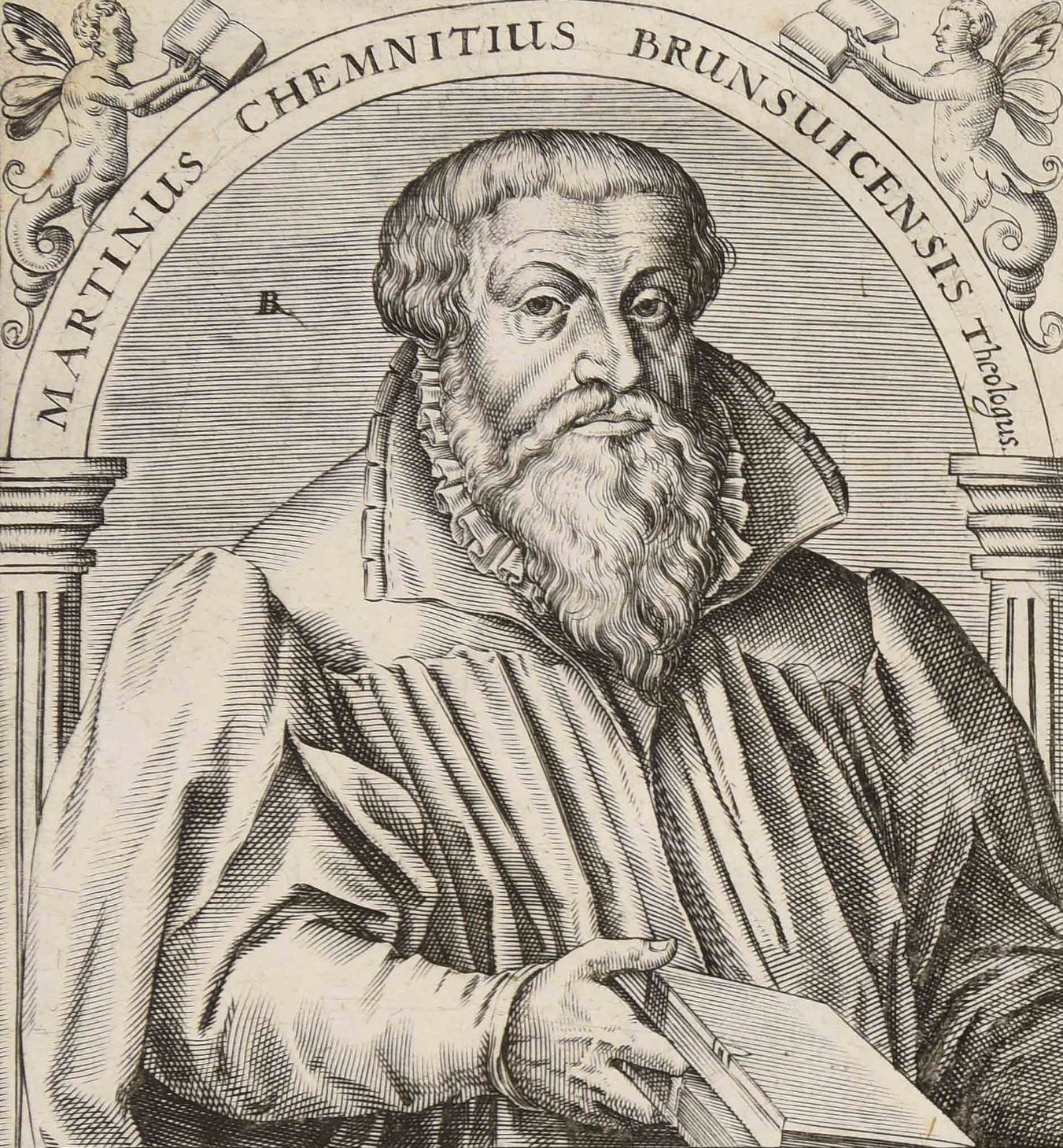
Here is the continuation of my translation of the original German text of Martin Chemnitz’s Enchiridion (1593). The current English translation of Chemnitz’s Enchiridion in Chemnitz’s Works is based chiefly upon a Latin translation that was composed during Chemnitz’s lifetime. Here is my translation of the previous section:

Square brackets and footnotes are my own notes and additions. Chemnitz does not supply verse numbers in the original German text.
Concerning Free Will
That is, Concerning Man’s Powers or Capabilities
117. Can a man then by himself begin and accomplish that which belongs to repentance?
No, for right true repentance is a gift of God (2 Timothy 2[:25]; Acts 2[:38]) and Peter says that “Christ has been exalted to God’s right hand as Prince and Savior to give repentance and forgiveness of sins” (Acts 5[:31]).
118. Does a man then have no free will?
Free will is what man can and is able to do with his understanding, heart, and will, either to understand something, to contemplate something, to undertake something, to attain to something or to flee from something, to do something or omit it. Nos as it pertains to sin, there man is all too “free from righteousness” (Romans 6[:20]), he indulges with understanding, heart, will, and all his capabilities in evil (Genesis 8[:21]), therefore it is miserable freedom, which is a slave of sin (John 8[:34]). Thereafter, as it pertains to worldly and external matters, discipline, and respectability, man can and is able to do something with his natural powers, for “the children of the world are more clever than the children of light in their generation” (Luke 16[:8]), they “do by nature the work of the law” (Romans 2[:14]), they can live blamelessly according to the Law (Philippians 3[:6]), although that same freedom is weak and hindered in manifold ways.
But as it pertains to Spiritual matters and dealings, as belongs to the entire conversion of man, repentance, faith, the new obedience, and whatever depends on these—whether to begin something, to bring about something, to do or accomplish something, to do something rightly in such a way as God’s Word requires it of him—from the first birth, man has no power or capability to do these things, indeed, he is opposed and contrary to them, as he is without the renewal of the Holy Spirit, for Scripture first takes away all such powers and capabilities from the natural man (1 Corinthians 2[:14]; 2 Corinthians 3[:5, 14]; Romans 8[:5, 7–8]; John 15[:4]; he is “darkness,” Ephesians 5[:8]; John 1[:13]; Acts 26[:18]; he is “dead in trespasses,” Ephesians 2[:1]; Colossians 2[:13]). Second, Scripture ascribes to him a stony evil heart that strives against God’s Word and is enmity toward God (Jeremiah 15[:20, 17:9]; Ezekiel 36[:26]; Romans 2[:5], 8[:7]).
119. Is there or can there be right repentance where there is no movement or change in the understanding, heart, and will of man?
No, for repentance is and signifies this: when man recognizes his sin, takes the threats of God’s wrath to mind and heart, fears Gods wrath for himself, becomes sorrowful over his sins, turns away from sin, has anxiety and distress of the heart that he might not be condemned, etc. And where such motion and change is not in a man, there is certainly also no upright repentance.
120. So, the mind, heart, and will of man nevertheless do and accomplish something in repentance?
The question is not about whether such movement and change are present and ought to be present in the conversion of man, for of that there is no doubt; rather, the question is: From where does man have and receive such movement and change? From where do the mind, heart, and will of man have and receive that which can begin, do, and accomplish that which belongs to repentance? Here, Scripture says plainly and clearly that man cannot do such of himself of his own nature by his own powers or capabilities, but rather such is a gift of God (Acts 5[:31], 11[:18]; 2 Timothy 2[:25]), who works such movement and change in man so that he can repent, as has been said; for it is God who converts man, who takes from him the stony heart and gives him a fleshly heart (Ezekiel 11[:19], 36[:26]). Therefore, Jeremiah says, “Turn to me, and I will repent to You, for You Lord are my God. When, I was turned, then I repented” (Jeremiah 31[:18–19a]).1
121. Can man then not strive against such conversion of God, hinder it, and thrust it away from himself?
Yes, unfortunately, and all too much and often. But the people ought to be instructed that they grievously sin in this, for they strive against the Holy Spirit, hinder Him, and disturb His working. For when God works such movement and change in men, when He gives and creates such powers and capabilities, so it is His will, intent, and command that we ought not receive His gift vainly or allow it to be idle in us (1 Corinthians 15[:2]; 2 Corinthians 6[:1]); but we ought to make good use of the received “talent” and diligently practice ourselves in it (Matthew 25[:14–30]), and not allow the old Adam in us to hinder or destroy such (Romans 6[:11–14], 8[:12–13]; Galatians 5[:1, 16–17, 24]).
122. So, may a man then sit and wait so long until God converts him, needing neither to hear nor consider the preaching of the Law?
No. This is not the right way, for God wants man to be converted, not without means, but has ordained for repentance a particular means and instrument through which He wants to work repentance in man, namely, the preaching of the Law, for this is “the ministry of death and condemnation” (2 Corinthians 3[:7, 9]). This preaching of the Law is an office, means, and instrument through which God wants to lead us in the knowledge of our sins, so that we fear His wrath and condemnation, and repent. Therefore, one ought to point to the Law and hold the people to such hearing and consideration of the Law and instruct them why they should love such rebuking sermons of God, because God thereby wants to work repentance.
The word for “turn” and “repent” is the same word in the German here (bekehren).